


A masked diffusion LLM generates text by repeatedly filling missing token positions. It starts with a prompt and a set of empty output slots represented by a special mask token. A neural network predicts what could belong in those slots; a sampling procedure reveals some predictions and runs the network again with the updated text. Ordinary next-token generation instead extends a completed prefix one token at a time.
In a recent practitioner discussion, users describe diffusion models as useful for rapid prompt variation while reporting mixed quality and speed, making useful output per generation pass a practical concern.
How can predicting several missing positions at once produce coherent text?
The model learns to predict from incomplete context, and successive passes make that context more complete. The sampler controls how much information becomes visible before the next decisions. That control connects the training objective to both generation quality and execution cost.
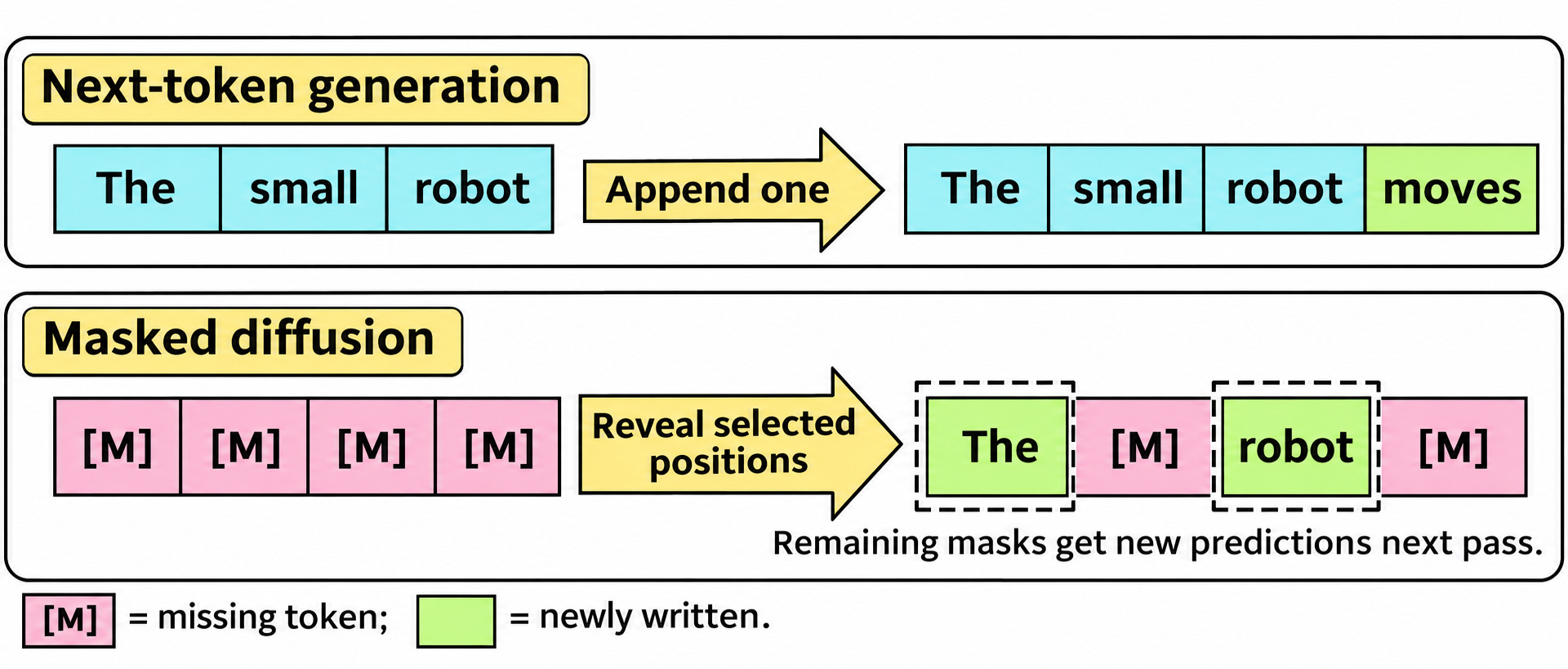
There is one distinction to keep in mind throughout: a prediction is not yet a committed token. A pass can propose words for every remaining mask while keeping only two. The other proposals disappear. On the next pass, those positions receive fresh predictions conditioned on the two newly visible words.
Two predictions made in the same pass share the same input, but neither gets to read the other's sampled token. That information becomes available only after the sampler writes the tokens into the next input. Parallel prediction is useful; deciding how much to commit together is a separate problem.
We will connect reconstruction training, reveal probabilities, an eight-position generation trace, and the actual sampler operations. Then we can account for what fewer passes save and what they repeat.
Contents
Learn from missing tokens
Turn predictions into a generation step
Follow eight positions through four passes
Why simultaneous choices can disagree
Read the sampler's state updates
Count the work behind the speed
