


LLM quantization represents a model’s numbers with fewer bits. Post-training quantization does this after the model has learned its weights. It maps those weights, and sometimes the changing numerical inputs called activations, onto a smaller set of representable values. The model still computes new answers, but its calculations now use approximations.
Serving engines such as vLLM support several quantization methods with different hardware requirements, making a smaller checkpoint a choice about execution as well as storage.
How can we remove precision without removing the computation that makes the model useful?
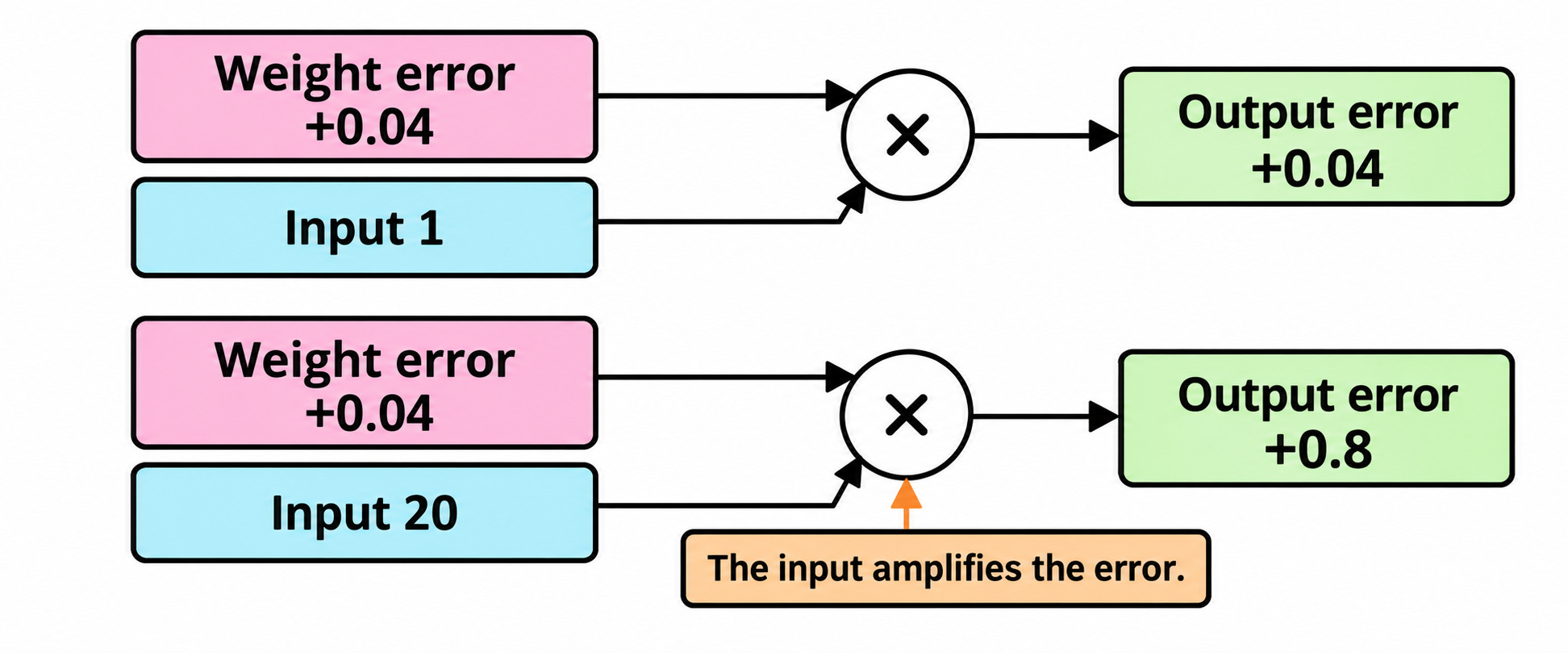
The central idea is to preserve what the numbers do together. A weight contributes to an output by multiplying an activation. A small weight error can matter greatly when its input is large. Errors in different weights can also reinforce or cancel one another.
We will follow three members of the post-training quantization family, organized by where they absorb that error:
GPTQ rounds a weight, then adjusts weights that have not yet been rounded to compensate for its effect.
AWQ, activation-aware weight quantization, rescales input channels so consequential weights get a more useful rounding grid.
SmoothQuant redistributes large activation values into the weights, making it easier to quantize both operands of a matrix multiplication.
These choices are related, but they are not three interchangeable file formats. GPTQ and AWQ are commonly used for weight-only compression. SmoothQuant addresses the additional difficulty of quantizing activations, and its transformation can be followed by GPTQ.
Here is the first useful distinction: the largest weight is not automatically the most important weight to preserve. Its effect depends on the input it multiplies and the other contributions to the output. That is why a conversion method may run calibration text through a trained model before deciding how to round its weights. It needs examples of the computation it is trying to preserve.
Table of contents
What rounding changes
GPTQ compensates across weights
AWQ changes the effective grid
SmoothQuant balances two operands
From compressed weights to execution
