


A retrieval-augmented generation (RAG) system answers with information fetched from an external collection. It usually prepares documents for search before a question arrives, then retrieves passages and places them in the language model's context. Editing a source document changes that external evidence. It does not automatically update the search index, cached answers, or the model's weights.
Daily Dose of Data Science's recent RAG systems coverage includes document synchronization, making the path from a source edit to a usable answer a concrete engineering concern.
How does a RAG system keep its evidence current when documents are edited, deleted, or restricted?
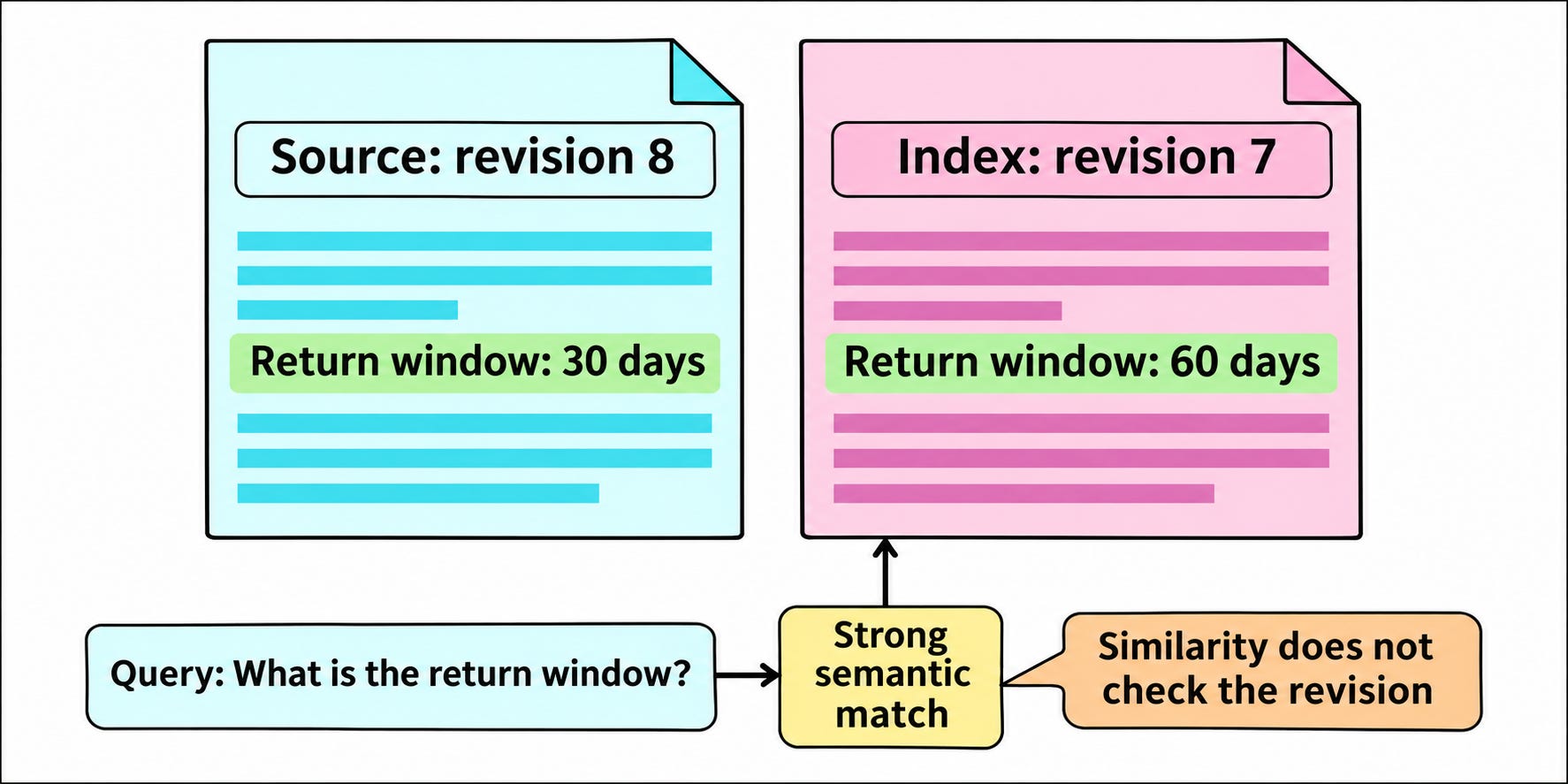
The useful mental model is a derived view with two interacting paths. The update path observes changes and builds searchable representations. The read path decides which retrieved representations may enter the answer. They meet at a small record of document state: what revision has been observed, which completed version is published, and whether the document may still be used.
One immediate consequence: a high similarity score cannot tell you whether a passage is current. A superseded policy can be an excellent semantic match for a question about that policy. Asking the answering model to prefer recent information cannot reliably repair an index that never supplied the replacement.
The system therefore needs two different capabilities: stop using evidence that has become ineligible, and make newly eligible evidence discoverable. A permission check can do the first while leaving the second completely unsolved.
We will follow the contracts connecting source capture, document generations, publication, retrieval, and reuse. The examples use illustrative revisions and offsets, not measured service timings. The goal is an adaptable architecture: which state must agree, where a transaction helps, and which gaps remain when components update independently.
Contents
The two paths behind a RAG answer
Capture every source change
Publish complete document versions
Admit only eligible evidence
Carry changes through caches and deletion
Choose and test the consistency boundary
