


An LLM can accept a very long prompt without treating every earlier piece the same way. The model represents each piece as an internal token state. Inside each attention layer, an eligibility rule determines which earlier states are available to the current token. Only then does the layer decide how much weight to give the available ones.
That first decision is the hidden trade-off behind sparse attention. The name suggests that the model merely turns down unimportant history. In many designs, it does something more consequential: it prevents most of the history from entering the main attention calculation at all.
A late-August 2026 Transformers release added Qwen Sparse Attention, while an open-weight Qwen model built on the same block-selection idea prompted immediate questions about long-context latency and cache placement; as more models save work this way, the durable question is which evidence they stop reading.
So here is the question we will answer: When sparse attention makes a long context cheaper, what does an LLM stop looking at?
The compact answer is that every attention pattern creates an eligible set of earlier token states. Full attention admits the whole past. A sliding window admits only nearby history. Content-selected sparse attention uses a cheaper scoring step to choose a small subset that can include distant history, then runs ordinary attention on that subset. Fewer eligible states mean less work, but a clue excluded at this point cannot be rescued by a larger attention weight later.
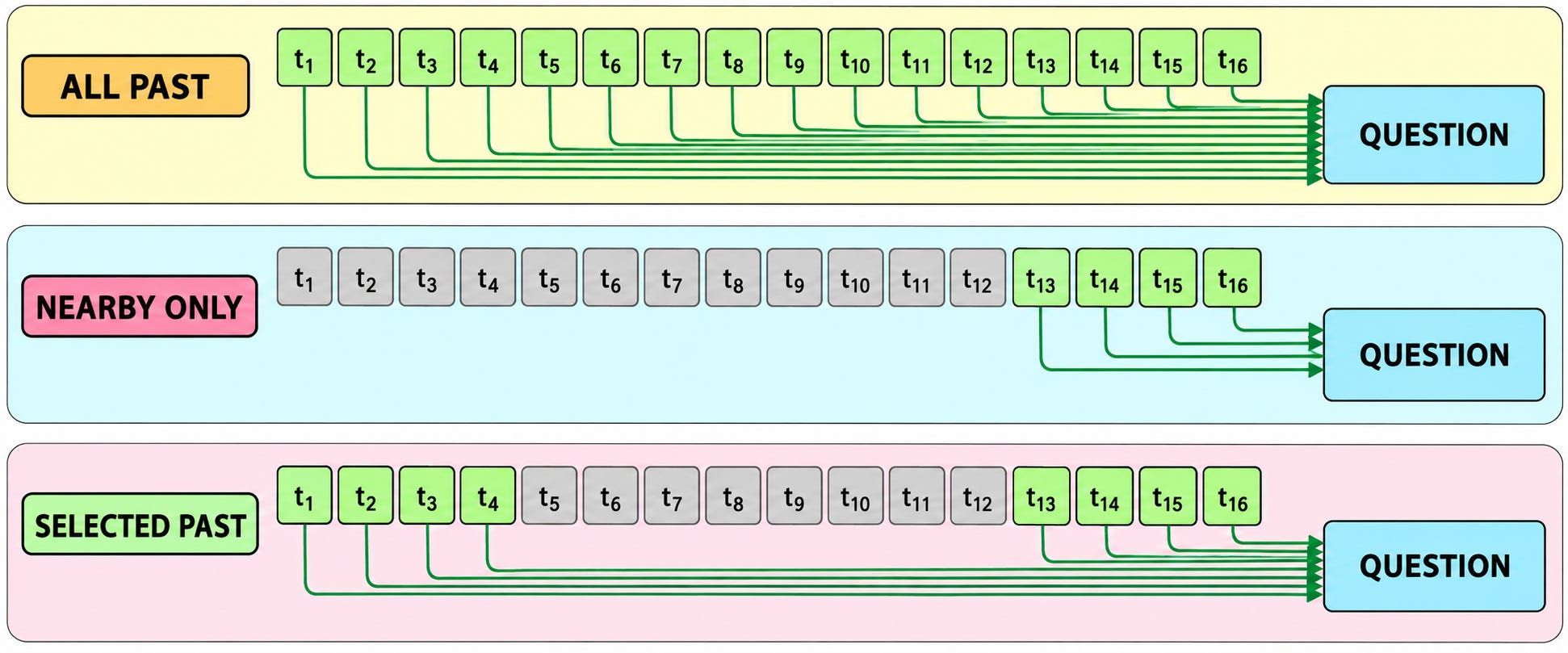
We will follow one question through all three patterns. A long incident report contains the deployed database proxy setting, port 6432, near the beginning. Much later, a diagnostic note mentions the default database port, 5432. At the end, the reader asks: Which port did the incident's database proxy actually use?
This is a useful test because the answer is a tiny exact value separated from the question by a lot of plausible noise. We will hold the tokens, model layer, and question fixed. Only the rule that exposes earlier states to attention will change.
Attention makes two decisions, not one
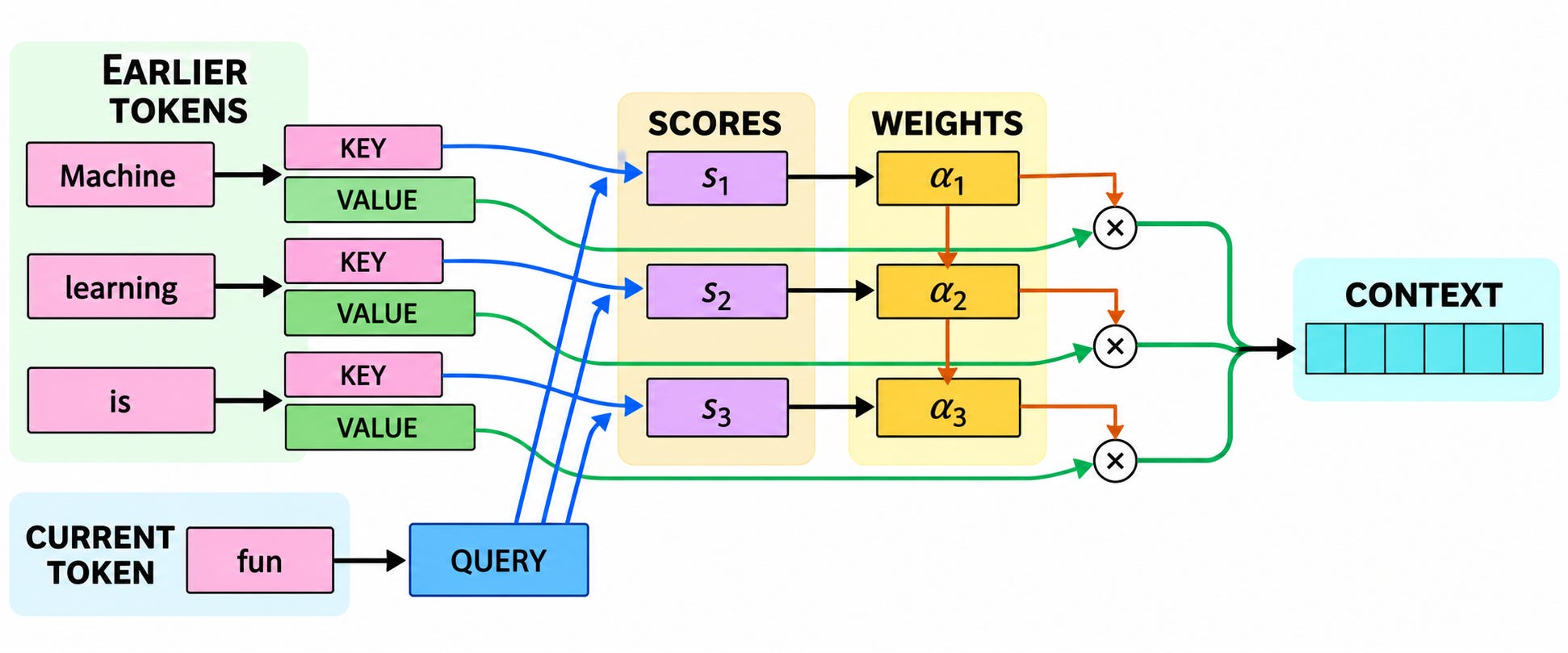
An LLM processes text as tokens, which are words or pieces of words converted into numerical states. At one layer, every token state is transformed into three useful roles.
Every token produces all three. When the layer updates the current token, its query represents what information it is seeking. The current token and earlier tokens provide keys, which can be compared with that query, and values, the information that can be carried forward. The query-key comparisons become weights; the weighted values become the context added to the current token's state. The diagram focuses on earlier sources, but causal attention also allows the current token to attend to itself.
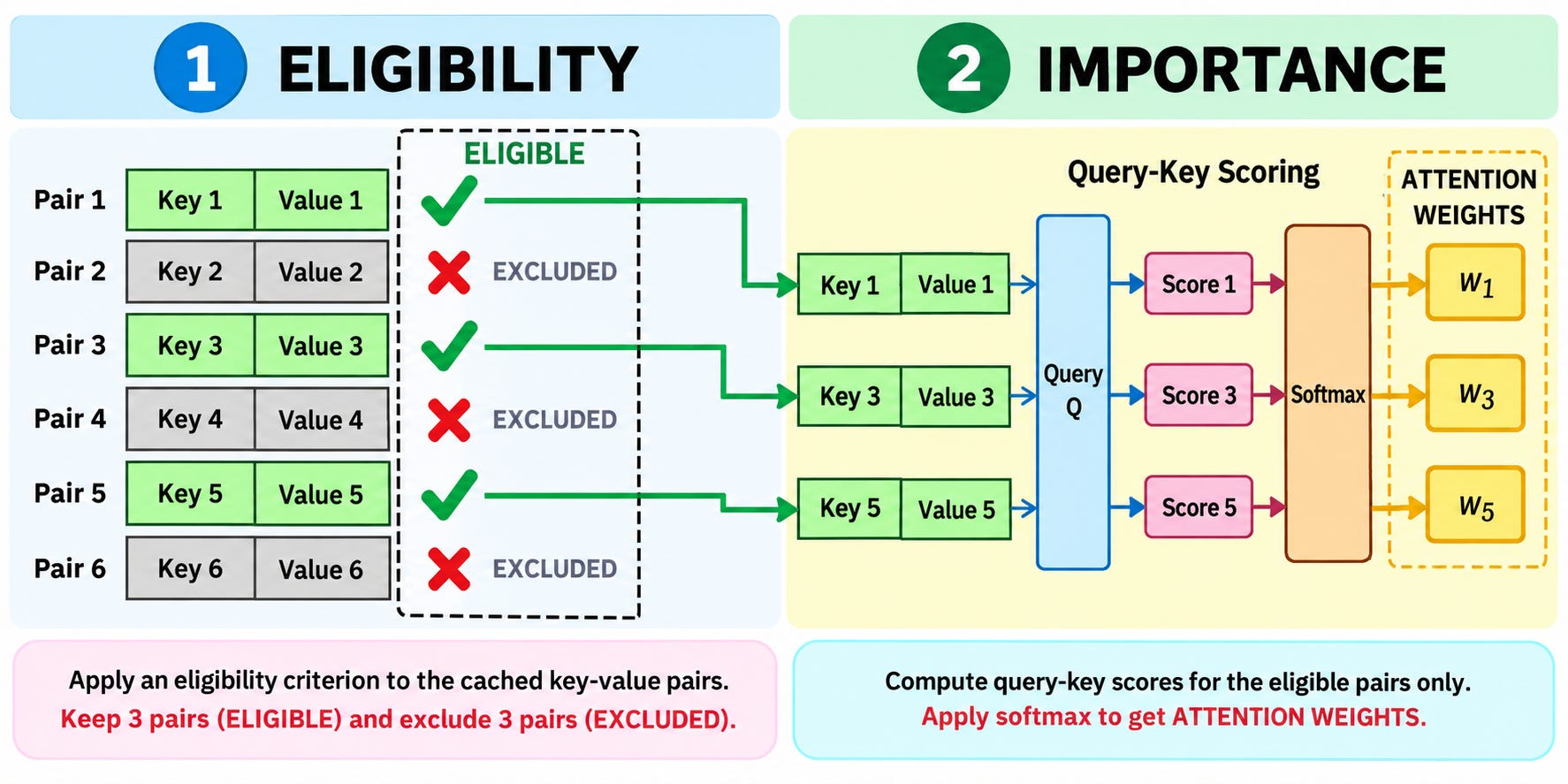
There is a prerequisite hiding before those comparisons. An attention rule supplies a mask or selection pattern that says which keys and values are eligible. A future token is ineligible in a causal language model because generation cannot look ahead. Sparse patterns add more exclusions among the past.
It helps to separate two questions:
Eligibility: may the current token connect to this earlier state?
Importance: among eligible states, how much weight should this one receive?
Full, windowed, and content-selected attention mainly differ on the first question. Once a subset is eligible, the main attention operation can still compare queries with keys and mix values in the familiar way.
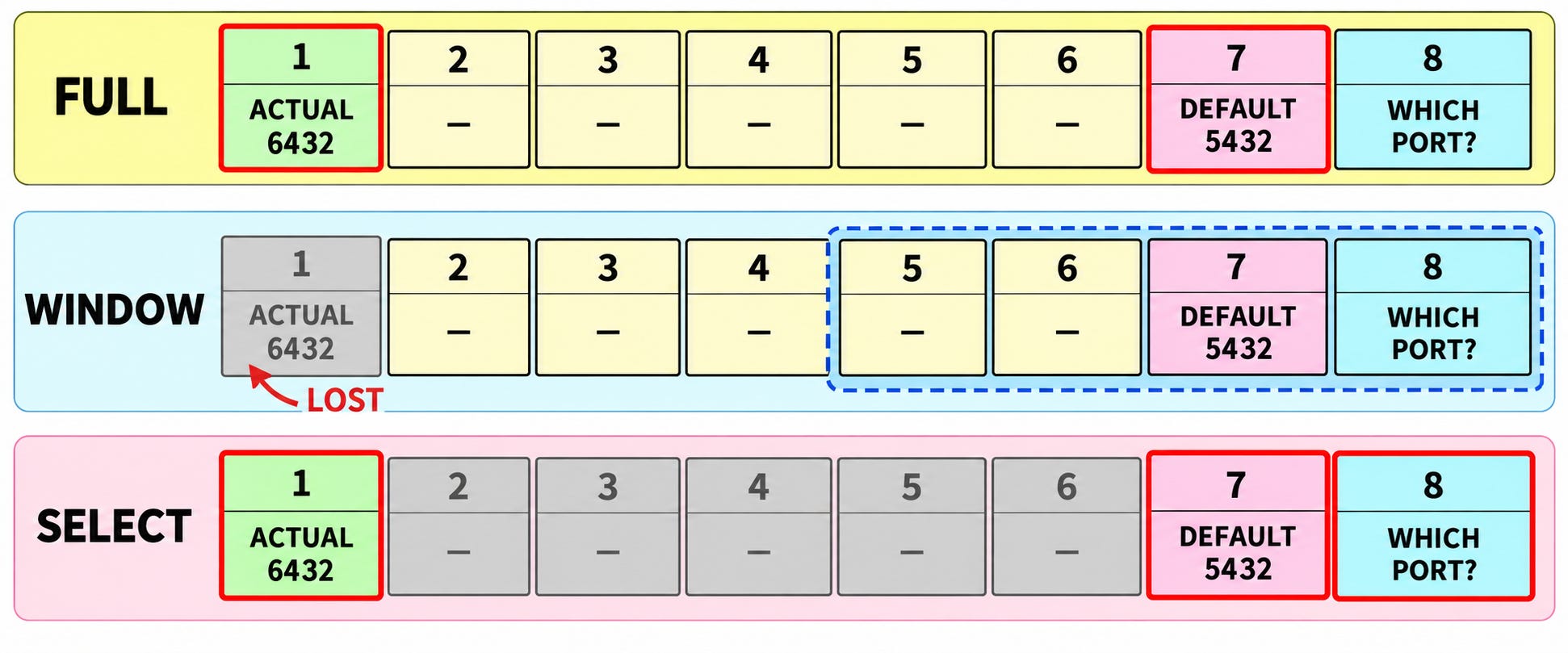
Apply that distinction to our incident report. Full attention places both 6432 and 5432 in the candidate set. A four-block sliding window includes only the late diagnostic note and loses the deployed setting. A good content selector reaches back to the configuration block containing 6432, while ignoring most of the middle.
The model still has to interpret the candidates correctly. Full attention could overweight the distracting 5432. A selector could choose the wrong block. Eligibility does not guarantee a correct answer; it defines which answer evidence remains possible at this layer.
That is the first complete mental model: sparse attention saves work before importance is calculated. The rest of the article explains how each eligibility rule buys its saving, and the distinct miss it creates.
